
Alternatives to OmniaKey
Explore the best alternatives and competitors to OmniaKey.
Explore 20 alternatives to OmniaKey. Compare features, pricing, and find the best fit for your needs.
OpenCheap
OpenCheap offers agents and developers one API for hundreds of models, routing calls by provider price and availability with pay-as-you-go billing.

HaryAI
HaryAI provides one API key for discounted chat, video and image models, with pay as you go access for apps and coding agents.

AI//COST
Explore verified LLM API rates, cost calculators and task benchmarks to compare models for practical workloads.

UnoRouter
UnoRouter routes hundreds of AI models through one OpenAI-compatible key and includes browser chat for users of coding and character clients.

Build to Launch MCP
Give Claude access to AI project workflows, practical guides, reusable prompts, and live-data lookup tools.

BrewPage
BrewPage publishes HTML, Markdown, files and small sites, and can save visitor responses for lightweight interactive pages.

Waifu Deck
Waifu Deck is a free, open-source Android app for browsing anime art and saving original images to a private, sortable collection.

Nitrozen
Nitrozen helps software teams publish product updates on public changelog pages or in an embeddable widget, with Markdown and developer tools.

DatafetchPro
DatafetchPro builds custom web scrapers, browser bots and API workflows, with source code and a fixed scope provided for each project.
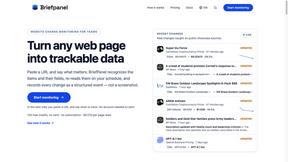
BriefPanel
BriefPanel tracks changes to individual items on public web pages and delivers structured history and alerts for teams, analysts, and automations.

ExpLint
ExpLint checks A/B test specifications for missing metrics, unclear outcomes, and other rule violations through MCP, API, or analytics.

BankBridge
Connect US bank accounts to supported AI agents for live, read-only answers about spending, recurring charges, cash flow, and investments.

Easemic
Easemic is an Android manga reader that brings supported catalogs and OPDS feeds into a shelf stored in cloud storage you control.

Ecommerce Data API
Ecommerce Data API offers marketplace research endpoints and request monitoring for developers building seller tools and workflows.

BlazePhoenix
BlazePhoenix provides contract-computed swap quotes on five networks, alongside self-custodial trading and developer integration tools.
NoMac
NoMac gives AI agents on-demand cloud Macs with Xcode, root access, and per-minute billing for building and shipping iOS apps.

SightRadar
SightRadar is a face recognition API for photo platforms, with selfie search, face comparison, detection, and per-photo pricing.

JevModel
JevModel combines a browser playground, visual decision flows, and an API for structured text classification and routing.
BillionVerify
BillionVerify checks email syntax, domains and mailboxes with live SMTP verification, plus bulk list cleaning and an API for forms and data pipelines.

HeyReagent
HeyReagent is a LinkedIn AI agent that drafts replies, follows up, and finds relevant people while keeping sending controls in your hands.
About OmniaKey Alternatives
Compare unified gateways such as OmniaKey with direct provider APIs. A unified account can simplify access across modalities, while direct integrations may suit teams that want to manage each provider connection themselves. Compare protocol support, model availability, billing units, task handling, and usage visibility.
FAQs about OmniaKey Alternatives
When is a unified API useful?
When an application needs access to several model providers or modalities through one account and usage surface.
When might direct provider APIs fit better?
When a team prefers to manage provider credentials and integrations individually.