

Frizzle
Frizzle turns snapshots of handwritten math into real-time analytics, showing teachers exactly who's stuck and what to teach next.
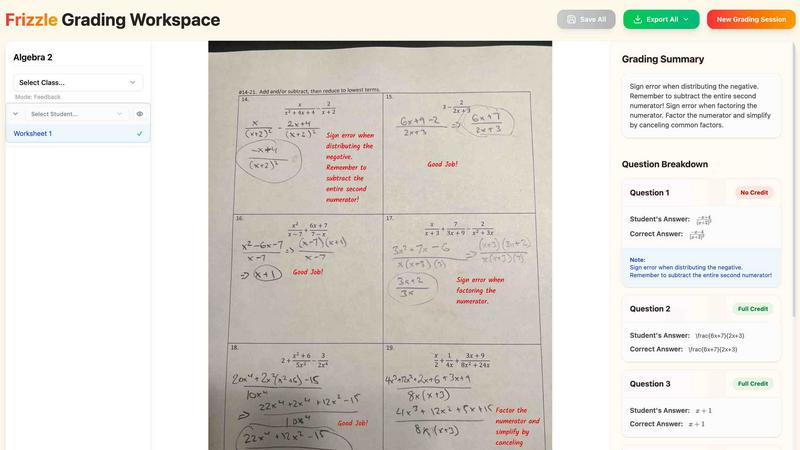
About Frizzle
Frizzle is the operating system for math classrooms that finally bridges the gap between paper-based learning and data-driven instruction. It uses computer vision and large language models to read, understand, and grade handwritten math work with 97% accuracy, turning a stack of papers into a live dashboard of student mastery in minutes. Students keep writing on paper, teachers keep teaching, and Frizzle handles the rest. The product is built for K-12 math teachers who are drowning in grading, instructional coaches who need actionable data, and school districts that want to cut screen time without losing visibility into classroom performance. Frizzle doesn't just mark answers right or wrong. It reads every step of student work, recognizes multiple solution paths, and tags 147 named misconceptions across K-12 math standards. A confidence-interval system flags uncertain grades for human review, so teachers never get blind trust in automation. The result is massive time savings. Teachers get back 10 to 15 hours a week they used to spend grading by hand. Coaches get specific standards-level conversations instead of generic walkthroughs. Districts get granular data on what each class and student has actually mastered, without waiting for spring assessments. Frizzle is already live in 30-plus schools and districts, including a college math pilot at Vanderbilt and Arizona State University. Over 142,000 problems have been read by 2,400 teachers, and the average class is processed in about eight minutes. It is FERPA and COPPA compliant, with end-to-end encryption and a strict policy that student work never trains its models. This is not a grading tool. This is a seeing tool for the math classroom.
Features of Frizzle
Handwriting Recognition and Step-Level Analysis
Frizzle reads any handwriting, including print, cursive, scribbled, and sideways text. It does not just check final answers. The computer vision parses each step of student work, understanding the journey a student took to reach a solution. This allows Frizzle to give step-level feedback, showing exactly where thinking went off track instead of just marking a problem wrong. It recognizes multiple solution paths and gives credit for all valid approaches, so three students who solve the same problem three different ways all get the points they earned.
Misconception Tagging and Prerequisite Tracing
Frizzle's model was trained on 1.4 million pages of real K-12 student work, giving it a deep understanding of how kids actually think and where they commonly go wrong. The system can identify 147 named misconceptions across K-12 math, each mapped to specific standards. It also performs prerequisite tracing, meaning it can detect when a seventh-grade error is actually rooted in a fourth-grade gap. Every flag links back to the exact stroke on the page, so teachers can see the evidence and understand the root cause.
Live Standards-Level Analytics Dashboard
After a teacher snaps a stack of papers, Frizzle processes the entire class and updates live dashboards within minutes. These dashboards show which Common Core State Standards each class and each student has actually mastered, which are developing, and which are at risk. Teachers can see who is stuck, which misconceptions are spreading through the room, and what to teach tomorrow. School and district administrators get aggregated anonymized signal across periods, grades, and buildings, enabling equity dashboards and curriculum effectiveness analysis.
Confidence-Interval Grading with Human Review Flags
Frizzle does not blindly trust its own grading. It operates with a confidence-interval system that measures how certain it is about each grade. When the system is not confident enough, it flags those papers for human review. This ensures that the 97% accuracy rate is backed by a safety net, catching edge cases, unusual handwriting, or novel approaches that the model might misinterpret. Teachers only need to review the flagged papers, not the entire stack, saving time while maintaining quality control.
Use Cases of Frizzle
Reclaiming Teacher Time from Weekend Grading
A high school Algebra I teacher with five sections and 150 students spends an average of 10 to 15 hours per week grading handwritten assignments. With Frizzle, they snap a stack of papers with their phone, doc cam, or copier, and the system reads every page in about eight minutes per class. The teacher gets back their weekends and can focus on lesson planning, small group instruction, and one-on-one student support instead of drowning in red pen work.
Running Specific Standards-Level Coaching Conversations
Instructional coaches often walk into classrooms with generic observation data. With Frizzle, coaches can see exactly which CCSS standards each class has mastered and which are lagging. A coach can walk into a meeting with a third-grade teacher and say, "Your class is at 92% mastery on multiplication facts but only 34% on fraction equivalence. Let's look at the misconception patterns." This shifts coaching from generic feedback to targeted, data-driven professional development.
Cutting Math Screen Time Without Losing Data
Many districts are trying to reduce the amount of time students spend on screens, but they still need granular classroom-level data to inform instruction. Frizzle solves this tension by keeping students on paper. They write, draw, and solve by hand. The teacher takes a single photo of the stack, and Frizzle digitizes the work and generates the analytics. Students get the cognitive benefits of handwriting, and districts get the data they need without adding more screen time to the school day.
Identifying Systemic Curriculum Gaps Across a District
A district math coordinator can use Frizzle's aggregated dashboards to see which curricula are actually working across all schools. If one school using Eureka Math shows 80% mastery on a specific standard while another school using Illustrative Math shows only 45%, the coordinator can investigate the root cause. Frizzle is curriculum-agnostic and reads work from Eureka, Illustrative, Saxon, and 30-plus state frameworks. This allows districts to make evidence-based decisions about curriculum adoption and professional development investments.
Frequently Asked Questions
How does Frizzle handle different handwriting styles and messy work?
Frizzle's computer vision model was trained on 1.4 million pages of real K-12 student work, which includes print, cursive, scribbled, sideways, and partially erased handwriting. The system is designed to recognize the messy and partial ways real students write. If the model is not confident about a particular page, it flags it for human review through the confidence-interval system. Over time, the model continues to improve, but student work is never used to retrain the model to protect privacy.
Does Frizzle replace the teacher's role in grading and instruction?
No. Frizzle handles the mechanical work of reading and grading so teachers can focus on the human work of teaching. The system returns granular data about what each student has mastered and where they are struggling, but it is the teacher who decides what to teach next, how to intervene, and how to support individual students. Frizzle also flags uncertain grades for human review, so teachers maintain quality control and final say over every grade.
Is Frizzle compliant with student privacy laws like FERPA and COPPA?
Yes. Frizzle is fully FERPA and COPPA compliant. The company undergoes SOC 2 Type II audits annually to verify its security practices. All data is encrypted with AES-256 at rest and TLS in transit. Critically, student work never trains Frizzle's models. The data stays inside the school or district's ecosystem and is not used for any purpose other than providing the service to that specific classroom.
What grade levels and math subjects does Frizzle support?
Frizzle supports K-12 math across all grade levels, with 147 named misconceptions mapped to standards. It aligns with Common Core State Standards, TEKS, and 30-plus state frameworks. The system has been used in elementary, middle, and high school classrooms, as well as in college math pilots at Vanderbilt University and Arizona State University. It reads work from any curriculum, including Eureka, Illustrative Math, and Saxon.
Similar to Frizzle

Zachai
Host exams for any class: handwritten papers, quizzes, essays and OMR sheets. AI drafts grades against your rubric; you edit and publish.

Verla AI
Verla is an AI academic assistant for university and college students, combining AI essay writing, academic research, AI detection, AI humanization, p

Parlune
Learn a language from real content, not vocab dumps. Parlune turns your favourite foreign-language YouTube videos into immersive, audio-synced lessons


MyGenogramMaker
Create family genograms online with standard symbols, relationship lines and editable templates.

Wordy
Learn languages with real movie and TV show clips.

WriteSprout
Create free printable handwriting worksheets for names, words, and sentences in seconds.

Aptitude Test Prep
Free timed practice for real employer aptitude tests