Anyrow vs Tickari
Side-by-side comparison to help you choose the right AI tool.

AI document extraction software that turns PDFs, scans, and emails into structured, editable tables.

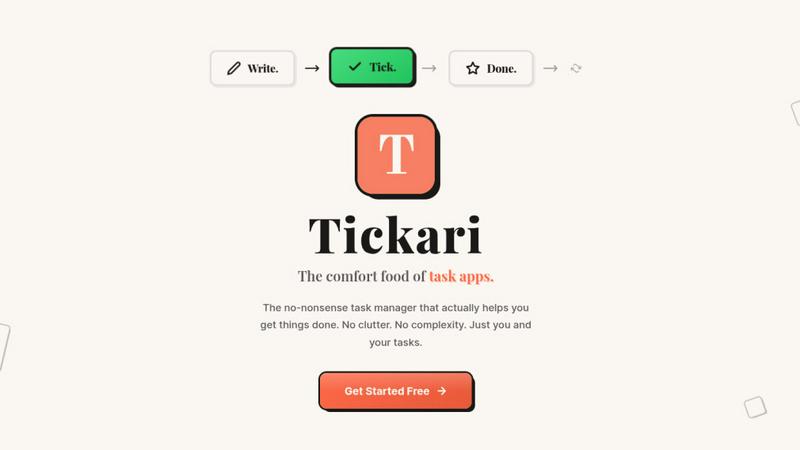
The no-nonsense task manager that actually helps you get things done. No clutter. No complexity. Just you and your tasks.
Visual Comparison
Anyrow

Tickari
Overview
About Anyrow
Anyrow is AI document extraction software that turns PDFs, scans, invoices, and emails into structured, editable tables. Define a schema with the column names and types you need, upload documents, and AI extracts matching rows automatically.
Built-in OCR, document classification, and field mapping handle every format — scanned, photographed, or digital.
What sets Anyrow apart is what happens after extraction. Tools like Parseur, Docparser, and Nanonets extract data and hand you a CSV. From there, teams build pipelines into Airtable, Google Sheets, or a database — adding cost, latency, and failure points at every hop.
Anyrow removes every hop. Extracted data lives in queryable, editable tables inside the platform with full CRUD. Teams review, correct, filter, and manage data without leaving the product.
For integration, Anyrow provides REST API access, CSV/Excel/JSON export, and webhook notifications. Connect extracted data to ERPs, accounting software, or internal systems directly.
Use cases: accounts payable automation, receipt processing, logistics document intake, insurance claims, HR onboarding, contract parsing.
Free tier available.
About Tickari
Tickari is a deliberately minimal, no-nonsense task manager designed for people who are tired of overcomplicated productivity tools and just want to get things done. Instead of overwhelming you with features like complex boards, AI-generated suggestions, or endless customization, Tickari focuses on a simple, frictionless workflow: write a task, tick it off, and move on.
The product embraces a “less but better” philosophy—eliminating clutter, reducing cognitive overhead, and removing the need for onboarding tutorials or setup processes. There are no distractions, no unnecessary decisions, and no feature bloat—just a clean interface that works instantly the moment you open it. This makes it particularly effective for users who feel stuck organizing tasks instead of actually completing them.