

DeepRails
DeepRails is your ultimate safeguard, detecting and fixing AI hallucinations before they confuse your users.
About DeepRails
DeepRails is your ultimate shield against the chaos of AI hallucinations, crafted specifically for developers and engineers who refuse to compromise on quality. In an era where large language models are the backbone of applications across industries—from customer support to legal research—the stakes are high. The risk of deploying inaccurate, unverified, or completely fabricated outputs can halt progress and erode trust. DeepRails confronts these challenges head-on as a comprehensive AI reliability platform. It doesn’t just identify potential issues; it actively detects hallucinations with razor-sharp accuracy, rectifying them before they ever reach your users. With tools designed for thorough quality control, DeepRails enables teams to rigorously assess outputs for factual correctness, grounding, and logical consistency. Its model-agnostic architecture integrates seamlessly into modern development pipelines, ensuring that you move from mere hope to absolute certainty. Trust DeepRails to empower your AI systems, allowing you to ship production-grade solutions that you can genuinely stand behind.
Features of DeepRails
Ultra-Accurate Hallucination Detection
DeepRails takes the guesswork out of AI reliability with its ultra-accurate hallucination detection feature. It scans AI outputs in real time, identifying and flagging potential inaccuracies before they become a problem. This proactive approach means you can catch errors early, preventing misinformation from reaching your users.
Comprehensive Guardrails to Fix Issues
When hallucinations are detected, DeepRails doesn’t just stop at flagging them—it actively provides solutions. With built-in tools like FixIt and ReGen, the platform offers corrective actions to fix inaccuracies instantly. This ensures that your AI outputs are not just detected as faulty but are also promptly repaired.
Customizable Guardrail Metrics
DeepRails gives you the power to create a suite of guardrail metrics tailored specifically to your industry. Whether you need general-purpose metrics or specialized ones, you can customize them to ensure your AI outputs meet your precise standards. Each metric can evaluate outputs with granular scoring, ensuring nothing slips through the cracks.
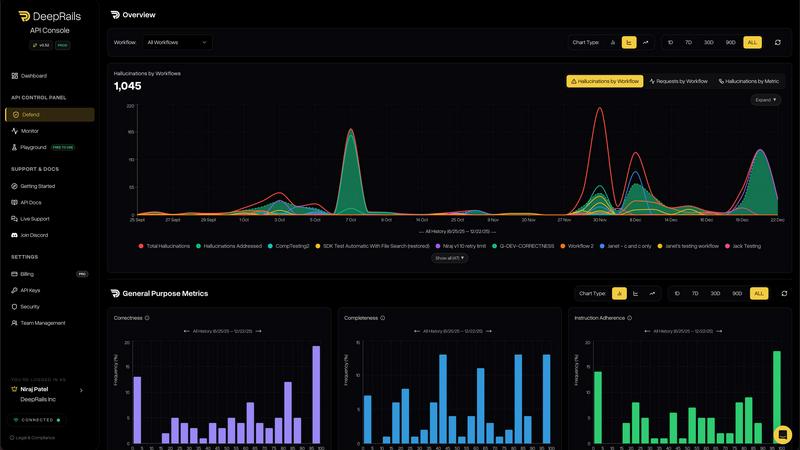
Real-Time Analytics and Performance Tracking
Stay ahead of the game with DeepRails' real-time analytics console. This feature provides metrics on hallucination detection, output accuracy, and performance trends over time. You can dive deep into detailed audit logs, gaining insights that help you refine your AI systems and enhance their reliability continuously.
Use Cases of DeepRails
Legal Research Applications
In the realm of legal research, accuracy is paramount. DeepRails ensures that AI-generated citations and legal advice are factually correct, safeguarding against costly errors. With its precision tools, law firms can trust their AI outputs to support their cases without fear of hallucinations.
Customer Support Automation
Deploying AI in customer support can significantly enhance response times. However, inaccurate information can lead to frustrated customers. DeepRails monitors and corrects AI responses in real time, ensuring that customer inquiries are met with reliable and precise answers, thus elevating the customer experience.
Healthcare Decision Support
In healthcare, misinformation can have serious repercussions. DeepRails guarantees that AI systems providing medical information or treatment recommendations adhere to factual accuracy. This feature is crucial for building trust between healthcare providers and patients, ultimately improving patient outcomes.
Financial Advisory Tools
Financial advice demands a high level of reliability. DeepRails equips financial institutions with the tools to ensure that AI outputs are grounded in verifiable data. By preventing hallucinations, the platform helps maintain regulatory compliance and builds client confidence in automated financial advice.
Frequently Asked Questions
What are AI hallucinations, and why are they a problem?
AI hallucinations refer to instances where AI models generate outputs that are inaccurate, unverified, or completely fabricated. These inaccuracies can mislead users and damage trust, making it essential to have a solution like DeepRails that actively detects and corrects these issues.
How does DeepRails integrate with existing development pipelines?
DeepRails is designed to be model-agnostic, allowing seamless integration with a variety of development environments and workflows. This flexibility ensures that teams can adopt DeepRails without overhauling their existing systems, making it a hassle-free addition to their toolset.
Can I customize the metrics used in DeepRails?
Absolutely! DeepRails allows you to create custom guardrail metrics tailored to your specific industry requirements. This ensures that your AI outputs are evaluated against the precise standards necessary for your domain, enhancing the reliability of your systems.
What kind of analytics does DeepRails provide?
DeepRails offers comprehensive real-time analytics that track performance metrics, hallucination detection rates, and output correctness. You can access detailed audit logs and performance trends, giving you valuable insights to continually refine and improve your AI systems.