Playwriter vs qtrl.ai
Side-by-side comparison to help you choose the right AI tool.

Playwriter
Give your AI agents the keys to your actual Chrome browser, complete with logins and extensions, via a single powerful command.
Last updated: March 18, 2026

qtrl.ai
qtrl.ai scales your QA with autonomous AI agents that you actually control.
Last updated: March 4, 2026
Visual Comparison
Playwriter

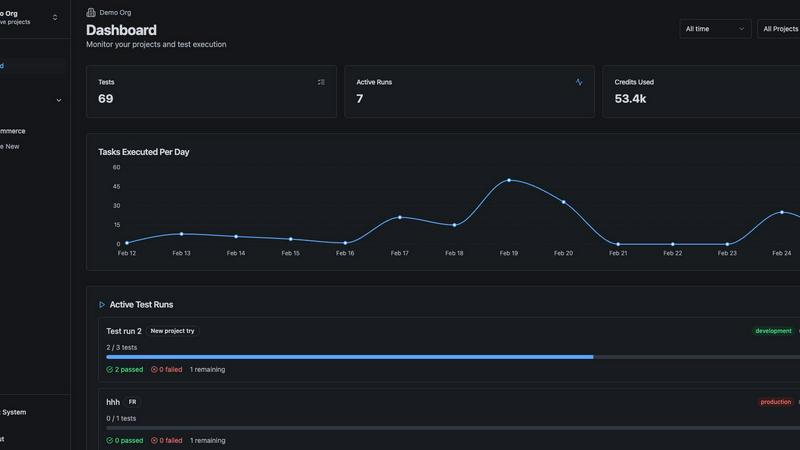
qtrl.ai
Feature Comparison
Playwriter
Your Real Browser, Zero Setup
Forget spawning memory-hogging, headless browser instances. Playwriter attaches directly to your existing Chrome session via a simple extension click. Your agents instantly inherit everything: logged-in accounts, ad-blockers, password managers, and session cookies. This means no instant bot detection, no tedious re-logins, and no doubling your RAM usage. The agent operates in the exact digital environment you do, bypassing the biggest hurdles of web automation with elegant simplicity.
One Tool to Rule Them All
Other systems force agents to use a limited, pre-defined set of brittle tools. Playwriter flips the script by exposing the entire, powerful Playwright API through a single execute command. This means your agent can run any Playwright code—clicking, typing, scrolling, waiting for elements, taking snapshots—without being constrained by a wrapper. It leads to more robust automation and lower context usage, as there's no schema bloat from dozens of individual tool definitions.
Built for Human-AI Collaboration
This isn't about firing and forgetting an agent into the void. Playwriter is built for real-time teamwork. You watch the agent work live in your browser. When it hits a captcha, you solve it. When a cookie consent wall pops up, you click it. If the agent gets stuck, you can temporarily disable control, manually fix the page, and re-enable it so the agent picks up right where it left off. You're sharing the driver's seat, not just reading a crash report.
Deep Debugging & Lightweight Snapshots
Playwriter comes packed with professional-grade dev tools. Use the built-in debugger to set breakpoints and pause execution. Edit code live to test fixes on the fly. Intercept and modify network requests. Record videos of sessions. Plus, its accessibility snapshots are a revelation: instead of bulky 100KB+ screenshots, it captures the page's semantic structure in a tiny 5-20KB file, giving your agent perfect "sight" of buttons, links, and fields without the visual bloat.
qtrl.ai
Autonomous QA Agents
These aren't your average, flaky bots. qtrl's AI agents are next-level operatives that execute your instructions on-demand or continuously, scaling across real browsers and environments. They operate within your rules, making autonomous decisions you can actually trust—no mysterious black-box voodoo. Real execution, real results, zero simulations.
Enterprise-Grade Test Management
Get your QA house in order with a centralized, no-BS foundation. Manage test cases, plans, and runs in one slick platform. Enjoy full traceability from requirement to release, built-in audit trails for compliance nerds, and seamless workflows that blend manual and automated testing. It's the governance powerhouse your security team will actually love.
Progressive Automation
Ditch the all-or-nothing pressure. Start by writing high-level instructions for humans or AI to follow. Then, smoothly transition to letting qtrl generate and suggest tests based on your coverage gaps. Every step is reviewable and refinable—you call the shots on when to increase the automation dosage. It's QA evolution, not revolution.
Adaptive Memory & Multi-Env Execution
qtrl gets smarter every day, building a living knowledge base of your app from every test run and exploration. This context-aware brain powers sharper test generation. Plus, execute everywhere—dev, staging, prod—with per-environment variables and encrypted secrets that are never exposed to the AI, keeping your configs locked down and consistent.
Use Cases
Playwriter
Automated Research & Data Aggregation
Send your AI agent on a deep-dive research mission across sites where you're already a member. It can log into your academic journals, navigate paid news sites, extract data from complex dashboards, and compile reports—all using your existing subscriptions and bypassing paywalls. The agent handles the tedious gathering; you get the curated insights.
Streamlined Testing & QA
Frontend developers and QA engineers, rejoice. Use Playwriter to create and run complex, real-user testing flows on your web app. Because it uses your real browser, it can test logged-in states, third-party integrations, and extension behavior that are impossible to replicate in a clean environment. Debug flaky tests instantly with live editing and network interception.
Repetitive Task Automation
Automate the boring stuff on sites that normally block bots. Have your agent handle routine order status checks on e-commerce sites, post scheduled content to social media platforms, or fill out internal company forms. Since it operates from your authenticated session, these workflows are reliable and human-like.
AI-Powered Web Interaction
Build next-level AI applications that need to interact with the dynamic web. Imagine an AI travel agent that can actually check flight prices on your logged-in airline account, or a personal shopper that browses your favorite stores. Playwriter provides the reliable, real-browser interface that makes these agentic applications possible and practical.
qtrl.ai
Scaling Beyond Manual Testing Hell
For QA teams drowning in repetitive click-throughs. qtrl provides the escape hatch, letting you structure manual tests first, then progressively introduce AI automation to handle the boring stuff. Scale your coverage and free your team to focus on complex, high-value testing scenarios without hiring an army.
Modernizing Legacy QA Workflows
Stuck with clunky, outdated tools and scripts that break if you look at them wrong? qtrl is your modernization path. It integrates with your existing stack and CI/CD pipelines, replacing fragile automation with intelligent, self-healing agents and bringing siloed testing into a single source of truth.
Governing Enterprise AI Testing
For large organizations where "move fast and break things" is a compliance nightmare. qtrl delivers enterprise-ready AI with permissioned autonomy, full visibility into every agent action, and ironclad audit trails. You get the speed of automation with the governance and security your legal and security teams demand.
Empowering Product-Led Engineering Teams
Squads that own their quality need tools that don't suck. qtrl fits perfectly, enabling developers and product managers to write tests in plain English, see quality metrics in real-time, and ship features faster with confidence. It's the QA sidekick that integrates into your workflow, not disrupts it.
Overview
About Playwriter
Tired of watching your AI agents trip over themselves in a sterile, sandboxed browser? Playwriter is the game-changer that finally gives them the keys to the real web. It's a Chrome extension and CLI that lets your AI agents—like Claude in Cursor or VS Code—control your actual, living browser session. No more fresh, cookie-less Chrome instances that scream "bot" and get blocked instantly. Playwriter plugs your agent directly into your browser, complete with all your logins, extensions, cookies, and settings already loaded. It's like giving your digital assistant a driver's license for your own car instead of making it learn on a broken-down simulator. It provides a full, unfiltered Playwright automation API through a single, powerful tool, enabling complex actions from performance profiling to network interception. Best part? It's open-source, runs locally on your machine, and turns browser automation from a frustrating chore into a seamless, collaborative dance between human intuition and AI execution.
About qtrl.ai
Tired of choosing between QA chaos and brittle, soul-crushing automation? qtrl.ai is the game-changer. It's the modern QA platform that finally bridges the gap, giving software teams the power to scale their quality assurance without losing their minds or their governance. Think of it as your centralized command center for all things testing: a slick hub to organize test cases, plan runs, trace requirements, and get real-time visibility into what's actually passing and where the gnarly risks are hiding. But here's the kicker—qtrl doesn't force you into a sketchy, black-box AI future. Instead, it layers on intelligent automation like a pro. Start with rock-solid manual test management, then level up when you're ready. Unleash autonomous AI agents that can spin up UI tests from plain English, keep them from breaking as your app evolves, and run them everywhere. Built for product-led squads, QA teams breaking free from manual hell, companies ditching legacy baggage, and enterprises that need airtight audit trails. qtrl's mission is simple: obliterate the trade-off between control and speed, delivering trustworthy, intelligent QA that actually scales with you.
Frequently Asked Questions
Playwriter FAQ
Is my browsing data sent to a remote server?
Absolutely not. Playwriter is designed with privacy first. Everything runs locally on your machine. The Chrome extension connects to a local WebSocket relay (on localhost:19988), and the CLI or your MCP client talks to that same local relay. No data, browsing history, or credentials are sent to any remote server. It's all in your control.
What happens if the agent gets stuck on a page?
This is where the collaboration shines. You can see the agent is stuck live in your browser. Simply click the Playwriter extension icon on that tab to turn it from green to gray, which detaches the agent. You can then manually navigate, solve a puzzle, or fix the page state. Once done, click the icon again to re-attach (turn it green), and the agent can continue its work from the new page state.
Can I use it with AI assistants other than Claude?
Yes! Playwriter works with any client that supports the Model Context Protocol (MCP), which includes Cursor, Claude Desktop, VS Code with extensions, and more. The core principle is providing a standard API (Playwright) that any capable agent can utilize through the local connection.
How is this different from just using Playwright directly?
Using Playwright directly typically means programmatically launching a separate, clean browser instance. Playwriter's magic is in attaching to your existing, authenticated browser session. This eliminates the huge problems of managing logins, avoiding detection, and replicating your unique browser environment (extensions, settings). It also adds the collaboration layer and lightweight snapshots that vanilla Playwright doesn't provide.
qtrl.ai FAQ
Is qtrl.ai just another "AI-washing" hype tool?
Absolutely not. qtrl is built on a foundation of serious test management first. The AI is a powerful, progressive layer you control. It suggests and generates tests you can review, executes within strict boundaries, and earns its autonomy by proving value—not by making unpredictable, black-box decisions. Trust is built, not assumed.
How does qtrl handle security and secrets?
With extreme prejudice. Secrets and environment variables are encrypted and never exposed to the AI agents. You get multi-environment execution with configs locked down per project. We're built for enterprises, meaning security, compliance, and data isolation aren't afterthoughts—they're the blueprint.
Can I really start with manual testing and add AI later?
100%. That's the whole vibe. Start by using qtrl as a powerful test management hub. When your team is ready, flip the switch on automation features. Let the AI agents generate tests from your instructions, suggest coverage gaps, and handle execution. You control the pace of your QA evolution.
What if the AI-generated tests are wrong or break?
You're always in the driver's seat. Every AI-generated test is fully reviewable and editable before it hits your suite. Combined with Adaptive Memory, the system learns from corrections and application changes, constantly improving its accuracy. It's a collaborative tool, not a replacement for your team's expertise.
Alternatives
Playwriter Alternatives
Playwriter is a game-changer in the automation category, giving AI agents the power to control your actual Chrome browser session. It solves the core problem of AI web browsing by providing a logged-in, extension-loaded environment instead of a sterile, bot-detected tab. People hunt for alternatives for all the usual reasons. Maybe the pricing doesn't fit their budget, or they need a feature that's still on the roadmap. Some might be locked into a specific platform or ecosystem that demands a different integration method. The search is totally valid. When you're evaluating options, look beyond the hype. The real magic is in session persistence—can the tool use your real browser with all your logins and extensions? Check the depth of control: is it just clicking, or can you intercept networks and edit code live? Finally, consider the license and how it plays with your existing AI workflow tools.
qtrl.ai Alternatives
So you're scoping out the scene beyond qtrl.ai. Smart move. qtrl is a next-gen player in the QA automation and dev tools space, built for teams who want to inject AI into their testing without losing their minds—or their governance. It’s that slick platform promising to bridge the brutal gap between slow manual checks and flaky automated scripts. People hunt for alternatives for all the usual reasons. Maybe the price tag doesn’t vibe with the startup budget, or the feature set feels like overkill for a lean squad. Sometimes it’s about platform fit—needing deeper CI/CD hooks, a different flavor of reporting, or an ecosystem that plays nicer with an existing tech stack. The quest is real. When you're weighing your options, cut through the hype. Look for something that matches your team's actual hustle. Do you need iron-clad audit trails, or just to automate the boring stuff? Is the AI assist actually trustworthy, or a black-box nightmare? Prioritize control, clarity, and a path that scales with you, not against you.